Amber Perfume: What It Actually Is and Why Everyone Is Drawn to It
Share
Ask someone to describe their favourite amber perfume and they'll reach for the same words: warm, enveloping, skin-like, magnetic. Amber is the note that makes a fragrance feel like it belongs on you — not just on you, but of you. It's the base that stays hours after everything else has faded, a low hum of warmth that follows you into the evening. And yet, most people have no idea what amber actually is. Not a single flower, not a single tree. Something altogether stranger and more interesting than that.
This is a deep dive. We'll cover what amber really is in perfumery, why it differs from ambergris, how perfumers build amber accords from scratch, how it behaves at different concentrations, and why it remains the note most likely to make a fragrance feel universally loved. Along the way, we'll look at how JOOJINA uses amber — specifically in YOU ARE SEXY — to create the sensation perfumers call magnetic pull.
Amber in Perfumery Is Not a Single Ingredient
This is the first thing to understand, and it changes how you read every fragrance description that uses the word. In perfumery, amber is an accord — a blend of several ingredients that together produce a warm, resinous, slightly sweet, and deeply resonant effect. There is no amber plant. There is no amber extract that you pour from a bottle. The note is constructed.
The classic amber accord draws from four principal materials:
Labdanum — a resin harvested from the cistus plant, native to the Mediterranean. Raw labdanum smells animalic and smoky; refined labdanum absolutes are dark and honied with a leathery undertone. It provides the depth and the slight wildness that gives amber its character.
Benzoin — a balsamic resin from the Styrax tree, grown in Southeast Asia and parts of China. It smells like warm vanilla crossed with baked goods — slightly sweet, comforting, with a dusty quality that keeps it from being cloying. Benzoin is the warmth in the warmth.
Vanilla — used in amber accords not as the prominent sweetness of a dessert fragrance but as a rounding agent. A small percentage of vanilla softens the sharper resinous elements and gives amber its welcoming quality. Without it, labdanum-forward accords can feel harsh.
Resins and balsams — opoponax (also called sweet myrrh), Peru balsam, and tolu balsam are common additions. Each one contributes a slightly different texture: opoponax is herbal and honeyed, Peru balsam is sweet and cinnamic, tolu balsam is softer and more powdery.
When a perfumer combines these materials, the result smells like nothing quite else. It is warm without being sweet. It is rich without being heavy. It has depth without demanding attention. And it behaves beautifully on skin because it shares certain chemical characteristics with the skin's own oils — which is why amber fragrances so often smell like "you, but better."
To understand how notes like amber fit into the full architecture of a fragrance, our piece on perfume notes explained covers the pyramid structure in detail — how top, heart, and base notes interact over the course of a wearing.
Amber vs. Ambergris: An Important Distinction
Ambergris is something completely different, and the confusion between the two is common enough to address directly.
Ambergris is a waxy substance produced in the digestive system of sperm whales and found — rarely — floating on the ocean or washed ashore. In its raw form, fresh from the whale, it smells foul. Aged over years at sea, it transforms into something extraordinary: marine and warm simultaneously, slightly fecal at high concentration but at low concentration producing what perfumers describe as a radiance effect — a halo of warmth that makes the fragrance project in a way no synthetic can fully replicate.
Ambergris has been used in perfumery for centuries. Today, both natural ambergris (legal if found naturally, since it's a byproduct rather than a hunted ingredient) and synthetic alternatives — most notably Ambroxan and Ambroxide — are used. These synthetics capture the radiant, skin-warming quality without the ethical and practical difficulties of sourcing natural ambergris.
The key point: when a fragrance says "amber," it means the resinous accord described above. When a fragrance says "ambergris" or "ambroxan," it means something marine and radiant and fundamentally different in character. Both are warm; both are used in the base. But they are not the same note, and they don't smell the same.
Some of the most compelling fragrances in contemporary niche perfumery use both — the resinous sweetness of the classical amber accord layered with the radiance of ambroxan. The effect is multidimensional: both deep and projecting, both sweet and clean.
Why Amber Is Universally Appealing
Warmth is one of the most basic human comforts. Amber smells warm. That alone accounts for a significant part of its appeal — it triggers associations with heat, with closeness, with safety. The olfactory system has a direct line to the limbic brain, which manages emotion and memory, which is why scent can produce such immediate and powerful feelings. Amber, with its warmth and its slight animalic character, tends to produce feelings of comfort, intimacy, and calm.
There's also a skin chemistry element. Amber accords are built from materials that have a molecular affinity with skin — they sink in, they warm up, they change. A fragrance with a strong amber base will smell different on different people, but almost always better. It uses the skin as a co-creator rather than a surface.
Amber is also a unifying note. A fragrance built around amber can carry citrus, florals, spices, or woods without any of them feeling disconnected. It's the base that makes things cohere. A perfumer with a strong amber foundation can add almost anything on top and have it resolve into something harmonious. This is why so many beloved fragrances — from classic orientals to modern niche compositions — have amber at their core.
Finally, amber is slow. It doesn't announce itself in the first five seconds like a bright citrus. It reveals itself over time — appearing in earnest in the dry-down, intensifying as the skin heats up, lasting long after everything else has faded. For people who prefer a fragrance that deepens throughout the day rather than fading out, amber is the answer.
How Different Perfumers Use Amber
The amber accord is a framework, not a formula. Different perfumers tilt it in different directions, producing radically different results.
The oriental approach pushes the sweetness — more benzoin, more vanilla, sometimes adding tonka bean and incense. The result is rich and enveloping, a fragrance that announces itself with warmth. Classic oriental fragrances from the early 20th century used this approach heavily, and it remains the reference point for "amber fragrance" in popular culture.
The contemporary niche approach often uses amber as infrastructure rather than signature — leaning heavily on ambroxan for radiance, using labdanum for depth, and keeping vanilla in check. The result is something that smells warm and skin-like without reading as "sweet" or "oriental." This is the approach that produces the fragrances people describe as addictive — the ones that make strangers lean in.
The woody-amber approach marries the resinous quality of amber with sandalwood, cedar, or vetiver. The wood and the resin reinforce each other — both are slow, both are warm, both improve with heat. JOOJINA's Eau Boisée works in this register: sandalwood and cedar provide the structural woody warmth, which amber deepens and extends. The result is a fragrance that smells like the forest floor in August — earthy, dry, and faintly sweet from the resins in the bark.
The floriental approach places amber under a floral heart — typically rose, jasmine, or iris. The amber provides the warmth that grounds the flowers and stops them from reading as purely pretty or fresh. Instead, they take on a sensual quality that transforms the whole fragrance.
Amber at Extrait Concentration: What Changes
Concentration changes everything about how a fragrance note behaves — and amber is one of the notes where the difference between eau de toilette and extrait de parfum is most dramatic.
In a light concentration, amber is a suggestion. You notice it in the dry-down, a warmth underneath everything else. It extends the fragrance's life and provides the base note structure, but it doesn't dominate.
In an extrait de parfum at 30 to 40% concentration, amber is present from the first moment. It doesn't wait for the opening notes to fade before asserting itself — it's there alongside them, giving the entire composition a warmth and density that a lighter formulation can't achieve. The projection is different too: extrait concentration doesn't broadcast the way a heavy application of eau de toilette might. Instead it creates an aura — a close warmth that someone notices when they're near you, not from across the room.
This is the register that perfumers describe as intimate. Not quiet — an amber-dominant extrait is never quiet. But close. Personal. The fragrance that makes someone lean in to ask what you're wearing.
The other effect of high concentration on amber: longevity. Amber is already one of the most tenacious note families in perfumery. At extrait concentration, it will often outlast the day — present in the evening when you've been wearing it since morning, and sometimes faintly detectable in the fabric of a jacket the next day. This is not a flaw. For many wearers, it's the point.
YOU ARE SEXY: How Amber Creates Magnetic Pull
The phrase "magnetic pull" is used loosely in fragrance marketing. But there's a specific mechanism behind it, and amber is central to that mechanism.
When a fragrance contains materials that are chemically similar to the natural oils and secretions of skin, it blurs the boundary between the fragrance and the person wearing it. You can't quite locate where the skin ends and the scent begins. This is the sensation people describe as "skin-like" or "like you but better." It's deeply attractive because it feels intimate rather than applied — as if the warmth and depth are coming from the person rather than something they put on.
JOOJINA's YOU ARE SEXY is built around this sensation. The amber accord at its core is warm, resinous, and slightly animalic — the kind of amber that doesn't whisper. It's bold from the first application, asserting a presence that fills the space around you without becoming aggressive. The warm musk that runs alongside it deepens the skin-like quality, pulling the fragrance even closer to the body's own warmth.
When you apply it, the opening is rich and immediate — you can feel the resinous warmth before you've even lifted your wrist from your neck. As it settles over the first thirty minutes, the sharpness of the opening softens and the amber takes full control: rounded, slightly sweet, deeply warm. By the dry-down, two to three hours in, it's become something that smells entirely of the person wearing it — the fragrance and the skin have merged.
That's the magnetic pull. It's not the fragrance attracting people to itself. It's the fragrance making you more magnetic. There's a difference, and it's the difference between wearing a scent and inhabiting one.
How to Find the Right Amber Perfume for You
Amber is a broad note family. "I like amber" is a starting point, not a destination. Here's how to narrow it down:
Do you want amber in the foreground or the background? If you want the amber to be the signature — the thing people notice and comment on — look for fragrances where it's explicitly the dominant note, not just a base element. If you want the warmth of amber to support something else (a floral, a wood, a citrus), look for accords where amber is listed as a base rather than a heart note.
How sweet do you want it? Amber can read very sweet (high benzoin and vanilla) or surprisingly dry (labdanum-forward with minimal vanilla). If you find most "warm" fragrances too gourmand or dessert-like, look for amber compositions that emphasise the resinous and slightly animalic character of labdanum over the sweetness of vanilla and benzoin.
What do you want amber to sit next to? Amber with woods (as in Eau Boisée) reads as earthy and grounded. Amber with musk (as in YOU ARE SEXY) reads as sensual and skin-like. Amber with citrus reads as warm-but-fresh. Amber with florals reads as soft and romantic.
Wear it, don't just smell it. Amber reveals itself slowly. The first five minutes of any amber fragrance are the least representative. Apply it to your wrist, leave it alone for two hours, then assess. What you smell at the two-hour mark is closer to what everyone else will smell on you all day.
| Amber Style | Key Character | JOOJINA Expression | Best For |
|---|---|---|---|
| Warm & Sensual | Amber + musk, skin-like, magnetic | YOU ARE SEXY | Evenings, date nights, anyone who wants a confident signature |
| Woody & Grounded | Amber + cedar/sandalwood, earthy depth | Eau Boisée | Daily wear, those who prefer warmth without sweetness |
FAQ
Is amber perfume suitable for warmer weather, or only for autumn and winter?
Amber is traditionally associated with the colder months because warmth compounds warmth — a rich amber fragrance on a hot summer day can feel heavy. But this is more about the overall composition than the amber itself. A lighter amber accord, sitting under a fresh citrus or a clean floral, works perfectly in spring and summer. The key is concentration and the notes surrounding the amber. At extrait de parfum concentration, less is more: a single application in warm weather can be enough for a full day without feeling oppressive.
What is the difference between amber and ambergris in a fragrance listing?
Amber refers to the resinous accord — labdanum, benzoin, vanilla, balsams — that creates warmth and depth. Ambergris (or its synthetic equivalents, ambroxan and ambroxide) is a marine, skin-radiant material with an entirely different character. Ambergris makes a fragrance project and glow; amber makes it feel deep and warm. They're often used together in the base of the same composition, but they're not the same thing. Some fragrance houses use "amber" loosely to indicate warmth without specifying the materials used — always worth reading the full notes list if you want to understand what you're smelling.
Why does my amber perfume smell different on my skin than in the bottle or on a strip?
Amber materials are oleoresinous — they behave very differently at skin temperature than at room temperature, and they interact with the natural oils and chemistry of your skin. On a cold strip, the accord is flat and uniform. On warm skin, it opens up: the volatile elements lift, the heavier resins meld with the skin's own warmth, and the result becomes genuinely personal. This is the intended experience. Any amber fragrance worth wearing should be evaluated on skin after at least ninety minutes, not in the bottle or on paper.
How should I apply an amber extrait de parfum to get the best effect?
Two or three points of contact is enough — wrists, the inside of the elbow, the base of the throat. Apply to warm skin, ideally just after a shower when the pores are open. Don't rub the application points together; this breaks down the molecular structure of the top notes and distorts the opening. Let it settle naturally. Amber is a base note that improves with time and warmth — your body temperature will do more work than any application technique.
Explore Amber on Your Own Skin
Reading about amber tells you the theory. Wearing it tells you the truth. Every skin transforms an amber accord differently — the same fragrance can read as darker and more animalic on one person and warmer and sweeter on another. The only way to know which direction it goes on you is to try it.
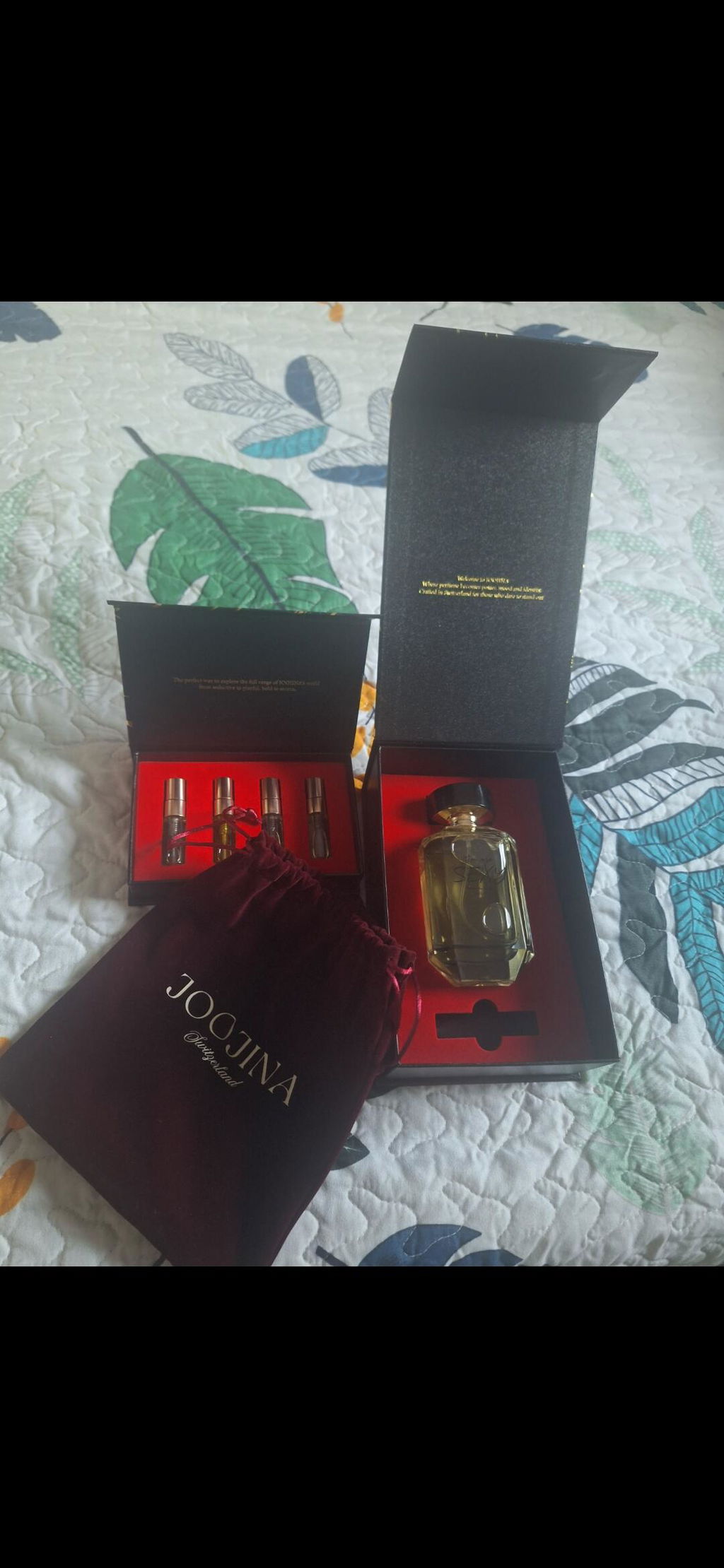
The JOOJINA Discovery Kit (€25, with a €25 voucher toward your full-size purchase) includes 3ml samples of all four JOOJINA fragrances — including the amber-forward YOU ARE SEXY and the woody-amber Eau Boisée. Wear them properly — a full day each, not a quick sniff — and see what amber does on your skin. Then choose the one you can't stop reaching for.
Browse the full JOOJINA collection and start with the Discovery Kit.
Related scent families
If you love amber, explore its warm relatives: vanilla, oud and musk perfume guides.