Best Spring Perfumes for Women 2026: What to Wear When the World Wakes Up
Share
Best Spring Perfumes for Women 2026: What to Wear When the World Wakes Up
By JOOJINA | March 2026 | 8 min read
Spring perfumes for women are not just a seasonal trend — they are a recalibration. When the light changes, when the air carries that first smell of wet earth and new leaves, your fragrance wardrobe shifts too. The heavy ambers and smoky woods that carried you through January start to feel like an extra coat you forgot to take off. What you reach for instead should feel like a breath: alive, present, neither too quiet nor too loud.
But here is where most advice falls short. "Spring fragrances" are typically described as light, airy, and fleeting — as though the season demands you disappear. That framing misses something important. The best spring scents are not timid. They are precise. They open brightly, develop with warmth, and leave something on the skin that makes people lean in. Achieving that requires understanding both the fragrance families at play and the concentration question that most brands never explain clearly.
If you want to go deeper on perfume fundamentals before reading on, our guide on the best perfumes for women covers how to evaluate a fragrance across its full development — a useful lens for everything discussed here.
What Makes a Great Spring Perfume for Women?
Three qualities define the best spring perfumes for women, and they are not mutually exclusive. You want radiance, longevity, and balance — a scent that projects without overwhelming, lasts without becoming flat, and moves between notes the way spring light moves through the day.
Radiance — The Opening That Earns Attention
A spring fragrance typically opens on something bright. Citrus (mandarin, bergamot, yuzu), green notes (cut grass, fig leaf, galbanum), or light florals (lily of the valley, white peony, freesia) create that first impression of freshness. The opening is not a promise — it is a declaration. It should smell intentional, not accidental.
The mistake many people make is selecting a fragrance based entirely on this top note. Top notes evaporate within 15 to 30 minutes. What matters is what they give way to.
Longevity — Where Concentration Becomes the Argument
Spring EDT and light EDPs are the obvious choice, and they often fail by 11am. The logic that a spring fragrance must be diluted is a marketing convention, not a fragrance law. An extrait de parfum at 30–40% concentration can deliver the same brightness in its opening while the base — sandalwood, musk, heliotrope, vanilla — holds for eight, ten, twelve hours. The sillage is quieter than a heavy EDP, but the skin scent persists.
This is precisely where a well-made extrait outperforms most spring releases. The depth is present from the first spray; it just does not announce itself aggressively. Think of it as the difference between shouting a beautiful sentence and saying it clearly. The meaning carries further than the volume.
Balance — The Accord That Does Not Tip
Balance in a spring fragrance means the top and heart never feel disconnected from the base. A citrus-forward opening that dries down to a powdery musk reads as coherent. A tropical fruit cocktail that crashes into heavy patchouli reads as two different fragrances fighting for the same skin. The best spring scents tell a continuous story: you can smell where they are going from the very first note.
The Three Fragrance Families to Know for Spring
Floral — The Classic, Reinterpreted
Florals are the dominant spring family, and with good reason. The season smells of flowers — mimosa in February, magnolia in March, wisteria and lilac in April. A good floral fragrance does not simply replicate that smell; it frames it. White florals (jasmine, tuberose, gardenia) run warmer and more opulent. Light florals (peony, lily of the valley, violet) lean fresher and more diurnal. A heliotrope-based floral sits somewhere in between: powdery, slightly sweet, with an almond edge that reads as skin-close and intimate.
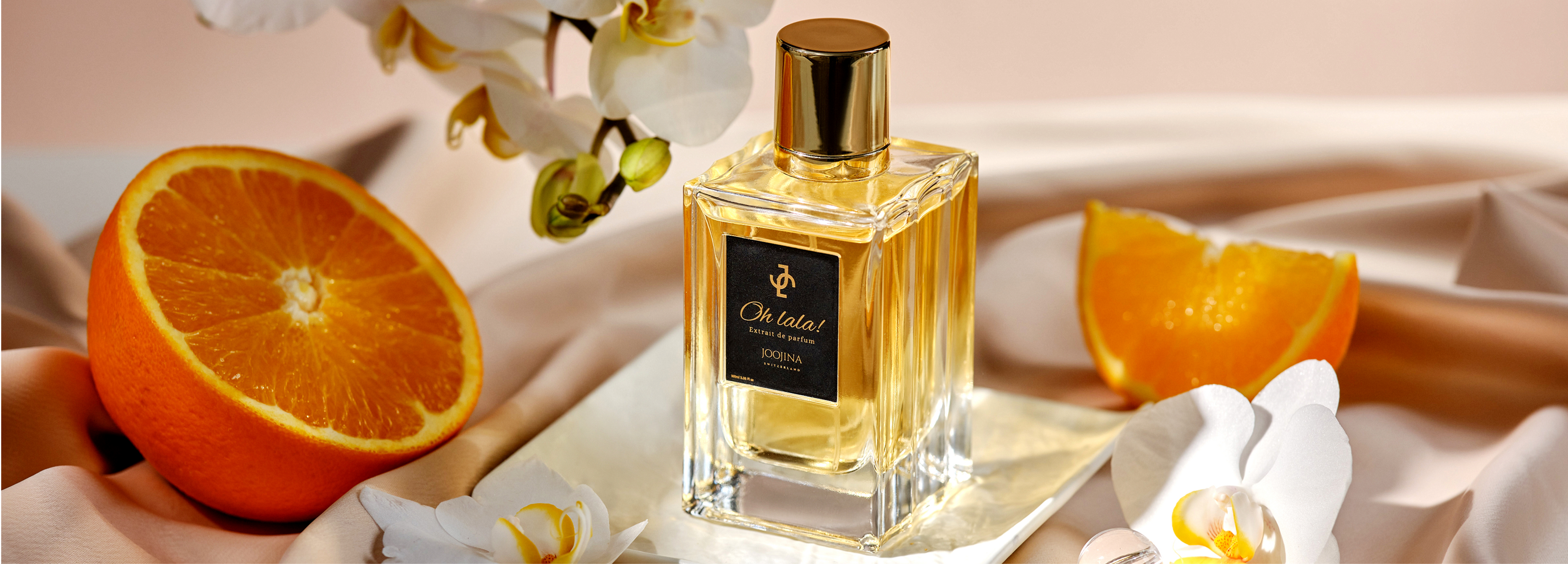
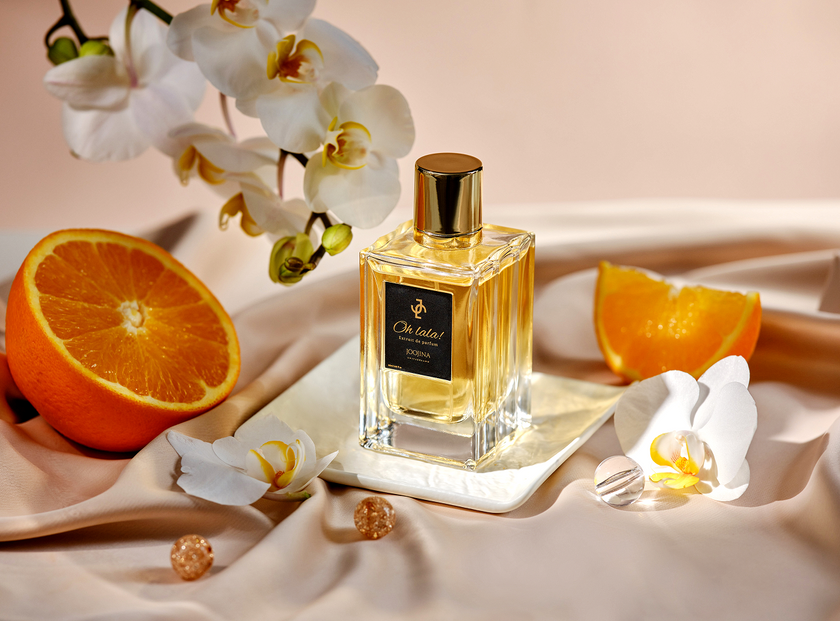
OH LALA! by JOOJINA demonstrates exactly this positioning. Mandarin opens the fragrance with that unmistakable brightness — zesty, slightly pulpy, like a fruit just split open. Heliotrope forms the heart: powdery, warm, with a softness that sits against skin without retreating. Vanilla grounds the base, keeping the whole accord from floating off into abstraction. Worn in spring, it reads as joyful without being obvious. The kind of fragrance someone notices across a table and wants to identify.
Citrus and Green — The Immediate Freshness
Citrus-dominant fragrances are the most instinctively appealing in spring, but also the most difficult to sustain. The challenge is that citrus molecules are inherently volatile — bergamot, lemon, yuzu all dissipate quickly, leaving a gap between the opening impression and whatever the base holds. A skillfully constructed citrus fragrance bridges that gap with green notes (providing vegetal freshness), white musks (providing skin warmth), or a woody anchor (providing longevity without heaviness).
Worn on a warm April morning, a citrus-green accord is one of the most viscerally satisfying smells in perfumery. It connects directly to sensory memory: the smell of a freshly mown lawn, a bowl of citrus on a kitchen table, a open window in the morning. The emotional resonance is immediate.
Fresh Woody — The Spring Alternative That Earns a Second Look
Woody fragrances are conventionally associated with autumn and winter, but fresh woodies — built on sandalwood, cedar, vetiver, or amyris rather than heavy oud or smoky woods — are exceptional for spring. They provide the structural depth that purely citrus-floral fragrances sometimes lack, while maintaining an airy character on the skin.
Eau Boisée from JOOJINA works precisely in this register. Sandalwood and cedar form the core — smooth, warm, slightly milky in the case of the sandalwood, dry and pencil-shaving-clean in the case of the cedar. The overall character is grounded rather than heavy. On warm spring skin, it develops a quiet intimacy: you smell it close, not from across a room, and that proximity makes it feel private, considered.
For women who find most spring fragrances too sweet or too obvious, a fresh woody is the counterintuitive choice that consistently surprises people. It signals confidence rather than cheerfulness — a different mode for the season, but entirely appropriate to it.
Spring Fragrance Checklist: How to Evaluate Any Scent for the Season
Use this table before committing to a spring purchase. Not every box must be ticked, but the more criteria a fragrance meets, the more confidently it will carry you through the season.
| Criteria | What to Look For | Red Flag |
|---|---|---|
| Opening brightness | Citrus, green, or light floral top note | Heavy resinous or incense-forward opening |
| Dry-down coherence | Heart and base feel like a continuation of the top | Sharp tonal break between notes |
| Projection vs. weight ratio | Noticeable sillage without density | Heavy projection that reads as oppressive in warmth |
| Concentration | EDP or extrait for longevity without heaviness | EDT that fades before noon |
| Skin reactivity in warmth | Develops positively as skin warms | Turns sharp, sour, or medicinal in heat |
| Seasonal versatility | Works from March through June across variable temperatures | Too light for 12°C mornings, too heavy for 22°C afternoons |
| Distinctiveness | Stands apart from generic "fresh" EDT releases | Indistinguishable from dozens of others on the shelf |
How Extrait Concentration Changes the Spring Equation
The conventional wisdom is that spring calls for light concentration. This is intuitive but incomplete. A 30–40% extrait de parfum does not behave like a winter fragrance poured into a spring bottle. The concentration affects persistence and depth — but the character of the ingredients themselves determines whether a fragrance reads as heavy or light. Sandalwood and heliotrope at extrait concentration are not oppressive. They are present.
JOOJINA's entire range is formulated as extraits de parfum — 30 to 40% concentration. This is intentional, and it creates a specific wear experience: the initial projection is controlled (not the aggressive cloud you might expect from an EDP), but the skin scent lasts. A single application of OH LALA! in the morning should still be detectable on skin by evening — a feat most spring EDTs cannot manage.
The extrait format also interacts differently with warm skin. As temperature rises through the day — particularly in spring when mornings are cool and afternoons climb — an extrait releases its base notes more slowly and evenly than a diluted EDT. You do not get the sharp spike of alcohol and top note on application, followed by a crash. You get a more linear, sustained release. For spring wear, where you might move between a cool office and a warm terrace, this is a meaningful advantage.
Two JOOJINA Fragrances to Consider for Spring
OH LALA! — For the Woman Who Wants to Be Noticed Without Trying
OH LALA! opens with mandarin — not the synthetic citrus used as a placeholder in mass-market fragrances, but a proper mandarin accord with both the sweet pulp note and the sharper zest. Within the first twenty minutes, heliotrope rises: powdery, warm, slightly almond-like, the smell of something soft pressing against bare skin. The vanilla base prevents any harshness. The overall impression is effortless warmth — the fragrance equivalent of stepping out into morning sun after a week of grey.
On cooler spring days (10–15°C), it sits closer to the skin and reads as intimate. On warmer days, it opens up into a fuller projection that remains entirely comfortable. It is not a fragrance that announces a season. It embodies one.
Eau Boisée — For the Woman Who Wants Something Quieter and More Singular
Eau Boisée does not read as a typical spring fragrance, which is precisely its strength. Where most spring releases compete to smell the freshest, the brightest, the most immediately appealing, Eau Boisée does something more interesting: it smells like a place. The cedar and sandalwood combination evokes clean dry air, wooden floors warmed by light, the specific scent of a room with windows open. There is nothing heavy or brooding about it. It simply smells quiet in the best possible way.
For women who find florals too decorative and citrus too transient, Eau Boisée offers a spring option that earns a long second look. It ages well through the day on skin, never turning sharp, always offering that smooth woody warmth as an anchor. Applied to wrists and the base of the neck on a spring morning, it is still present seven hours later — quieter, warmer, closer.
How to Wear Spring Fragrances Well
Application technique matters more in spring than in any other season. The temperature variability — cold mornings, warm afternoons, indoor/outdoor transitions — means that where and how you apply a fragrance will shift its character noticeably.
Apply to warm pulse points, not clothes. In spring, skin-to-scent interaction is what you want. The gradual release of fragrance as your skin warms through the day is the mechanism that makes extrait concentration so effective. Spraying on fabric reduces that interaction significantly.
Apply sparingly in the morning, then assess. A common mistake is applying the same quantity in spring as in winter. Warmer skin amplifies projection. Two sprays of an extrait in spring may equal the perceived intensity of three or four sprays of an EDT in winter. Start with less, evaluate after fifteen minutes, add if needed.
Use the hair if you want extended sillage. Hair holds fragrance exceptionally well — the natural oils trap scent molecules. A single spray held at arm's length directed toward dry hair adds a subtle, persistent trail without competing with the skin application.
Moisturize first. Unscented body lotion or a fragrance-free moisturizer applied before a fragrance creates a better base for the molecules to adhere to. Dry skin consumes fragrance faster. Moisturized skin holds it.
Frequently Asked Questions
What fragrance notes are best for spring?
The most reliable spring notes are citrus (mandarin, bergamot, yuzu), light florals (heliotrope, peony, lily of the valley), green notes (fig leaf, galbanum, violet leaf), and soft musks. Fresh woodies — sandalwood, cedar, amyris — also work well in spring, especially as heart and base notes that anchor brighter top notes. Heavy resins, incense, and thick musks tend to feel out of season in warmer temperatures, though this depends more on the full formula than on individual notes in isolation.
Should I switch fragrances completely in spring, or can I wear year-round scents?
You do not need to own a separate spring wardrobe unless you want to. Many well-constructed fragrances — particularly extraits with balanced accords — adapt well across seasons. What changes is how they perform: a woody fragrance that reads as warm and grounding in November reads as clean and structured in April. The shift is worth being aware of, but it is rarely a reason to retire a fragrance entirely. If a scent feels oppressive in spring warmth, that is your cue to set it aside. If it still feels right, trust that.
How do I find the right spring fragrance without buying blind?
Test on skin, not paper. Paper gives you the top note and nothing else — it will not tell you how a fragrance develops, how it sits on your specific chemistry, or how it performs through a full day. Apply to the inside of your wrist in the morning, go about your day, and evaluate at noon and again in the evening. The dry-down and the base are where a fragrance earns its keep, and you will only find them on skin after time.
Is extrait de parfum too heavy for spring and summer?
Not inherently. Concentration determines longevity, not weight. An extrait built on fresh, light accords — citrus, floral, clean woody — will not feel oppressive in warmth. What determines heaviness is the character of the raw materials: dark musks, heavy resins, dense oud. A well-formulated extrait with spring-appropriate ingredients delivers the depth and longevity an EDT cannot match, without the density you might associate with winter fragrances. JOOJINA's extraits are formulated specifically with this in mind.
Try Before You Commit
Spring is the best time of year to explore your fragrance wardrobe — the season rewards curiosity and the skin is receptive. If you are not ready to invest in a full 50ml bottle of something untested, the JOOJINA Discovery Kit was built for exactly this moment.
For EUR 25, you receive four 3ml samples of all four extraits — including OH LALA! and Eau Boisée — giving you a full week of wear on each to evaluate how they develop across a spring day. The kit also includes a EUR 25 voucher redeemable on any full-size purchase. It is not a sampler — it is a decision tool.