Is Extrait de Parfum Worth It? Here's the Truth
Share
Is Extrait de Parfum Worth It? Here's the Truth
By JOOJINA | March 2026 | 8 min read
The question comes up constantly: is extrait de parfum worth it when you can buy two bottles of eau de parfum for the same price? It's a fair question, and it deserves a straight answer — not a sales pitch. So let's do the actual math, look at what goes inside these bottles, and figure out whether the premium is justified or whether you're paying for a fancy label.
Short answer: for most people who wear fragrance regularly, yes — extrait de parfum is worth it. But the reasoning is more interesting than you might expect.
The Cost-Per-Wear Math Nobody Shows You
Let's compare two real-world scenarios. You have a 50ml eau de parfum at EUR 80. Concentration: around 15-20% aromatic compounds. On your skin, in normal conditions, you get 3-5 hours of solid projection before it fades to a skin scent. Realistically, to smell good through a full workday and an evening, you're reaching for the bottle at least twice. That's 2 sprays in the morning, 2 more at lunch. Four sprays per wear day.
A 50ml bottle holds roughly 500 sprays. At 4 sprays per day, that's 125 wear days. Cost per wear: EUR 0.64.
Now take a 50ml extrait de parfum at EUR 160. Concentration: 30-40% aromatic compounds. Two sprays in the morning, and you're still radiating warmth and depth twelve hours later. You do not reach for the bottle mid-day. Two sprays per wear day.
Same 500 sprays. At 2 sprays per day, that's 250 wear days. Cost per wear: EUR 0.64.
Identical. And that's before accounting for the fact that extrait de parfum often performs better in heat, doesn't require reapplication during a dinner where excusing yourself to the bathroom to spritz your neck would be awkward, and typically smells more complex and evolved across those twelve hours rather than fading to a flat linear whisper.
The math actually tilts in favour of the extrait when you factor in the full experience. A fragrance that needs reapplication is one that's failing at its job halfway through. You bought it to smell good all day — if it only delivers for four hours, you're paying for something incomplete.
For a deeper comparison of how concentration affects performance, read our full breakdown in Extrait de Parfum vs. Eau de Parfum: What's the Difference?
Is Extrait de Parfum Worth It When You Look Inside the Bottle?
The higher price isn't just about concentration. It reflects what's actually in the formula.
Iris butter — one of the most prized materials in perfumery — costs more per kilogram than gold. Not metaphorically. At market prices, high-grade iris butter has sold for EUR 80,000-100,000 per kilo. A single kilogram of Grasse rose absolute can run EUR 5,000-8,000. Oud oil from old-growth agarwood in Assam or Borneo can reach EUR 30,000-50,000 per kilo.
A fragrance house working at high concentration needs significantly more of these materials per bottle than one working at EDP strength. If a formula contains 5% iris at EDP concentration, an extrait version at twice the concentration needs 10% iris. That cost doubles in the formula, and it shows up in the price.
Mass-market perfumes sidestep this by replacing natural materials with synthetics, diluting formulas aggressively, and filling bottles with a high proportion of alcohol and carrier. There's nothing inherently wrong with synthetics — some are extraordinary materials — but when a EUR 40 designer fragrance smells thin and sharp on the skin and disappears in two hours, you're seeing the result of that cost-cutting.
Niche extrait houses like JOOJINA make a different choice: use the real materials, use them at meaningful concentrations, and charge accordingly. The price reflects the formula, not a celebrity contract or an advertising budget that dwarfs the cost of the juice itself.
The "Luxury Tax" Misconception
There's a persistent idea that luxury perfume prices are largely fictional — that you're paying for the name, the bottle, the status, and not the scent. This is true for some products and completely false for others, and conflating the two leads to bad purchasing decisions in both directions.
Yes, some prestige perfumes from major fashion houses charge EUR 200 for a formula that costs EUR 4 to produce, packaged in a EUR 12 bottle. The rest is brand equity, retail margin, and marketing. In those cases, you are paying a luxury tax.
But a small niche house with no advertising budget, no celebrity fronting the campaign, and no department store distribution has no luxury tax to hide behind. The price of a JOOJINA extrait reflects what's in the bottle, what it costs to source Swiss-quality ingredients, and what it costs to produce in small handcrafted batches. When Joanne Désirée Franck — who trained at ISIPCA in Versailles and worked with houses like Chanel, Guerlain, and Clarins — formulates a fragrance, she's not padding a formula to hit a price point. She's working with the best materials available and pricing at what that actually costs.
The distinction matters because it changes how you should evaluate the purchase. A EUR 160 extrait from a niche Swiss house is a different category of product than a EUR 160 designer fragrance. Same price. Completely different calculation.
How Extrait de Parfum Actually Behaves on Skin
The difference isn't just longevity. An extrait de parfum evolves differently across its life on your skin, and this is something you genuinely need to experience to understand.
An EDP tends to announce itself loudly in the first hour — bright citrus, sharp florals, clean woods — and then fade relatively linearly toward its base. What you smell in hour one and what you smell in hour four are different in intensity but broadly similar in character.
An extrait opens more quietly and then unfolds. The concentration means there's more happening at every stage. Top notes appear, then pull back to reveal heart notes you didn't notice at first application, then a base develops hours later that can be genuinely surprising — richer, darker, warmer than anything in the first spray. It's a narrative rather than a single note held at diminishing volume.
Take YOU ARE SEXY, JOOJINA's bold extrait built for presence and sensuality. Applied in the morning, the opening is confident and direct. By mid-afternoon, the heart has deepened into something warmer and more intimate. By evening, it has become something you feel as much as smell — a skin-close warmth that draws people in rather than projecting outward. That progression is only possible at extrait concentration. An EDP version of the same formula at 18% wouldn't have the material depth to do that.
For a full breakdown of how to make any fragrance — EDP or extrait — last as long as possible, see our guide: How Long Does Perfume Last? And How to Make It Last Longer.
When Extrait de Parfum Is Not Worth It
Honesty requires saying this: there are situations where extrait is not the right choice.
If you wear fragrance casually and inconsistently — a few times a month, maybe at social events — an EDP is perfectly adequate and buying an extrait means the bottle sits unused for months between openings, which is its own form of waste. Fragrance degrades over time once opened; a bottle you'll take 3 years to finish is not getting the best of what's inside it.
If you're new to niche perfumery and haven't developed a strong sense of what you like, buying a full bottle of extrait at EUR 100-160 before you know whether the fragrance works on your skin is a significant gamble. Fragrance is deeply personal — the same extrait that smells extraordinary on one person can smell flat or wrong on another due to skin chemistry, body temperature, and pH. No amount of reading reviews tells you how it will smell on you.
And if you are simply looking for a light, fresh spritz for the gym or a casual Saturday — a lighter concentration is genuinely more appropriate. Extrait for a workout is like wearing a wool coat in July. Technically functional, contextually wrong.
The Smart Way to Try Before You Commit
Given that extrait de parfum is an investment, and given that skin chemistry is unpredictable, the rational approach is to test at extrait concentration before buying a full bottle. Not a paper strip — that tells you nothing useful about how a fragrance wears. On your skin, through a full day.
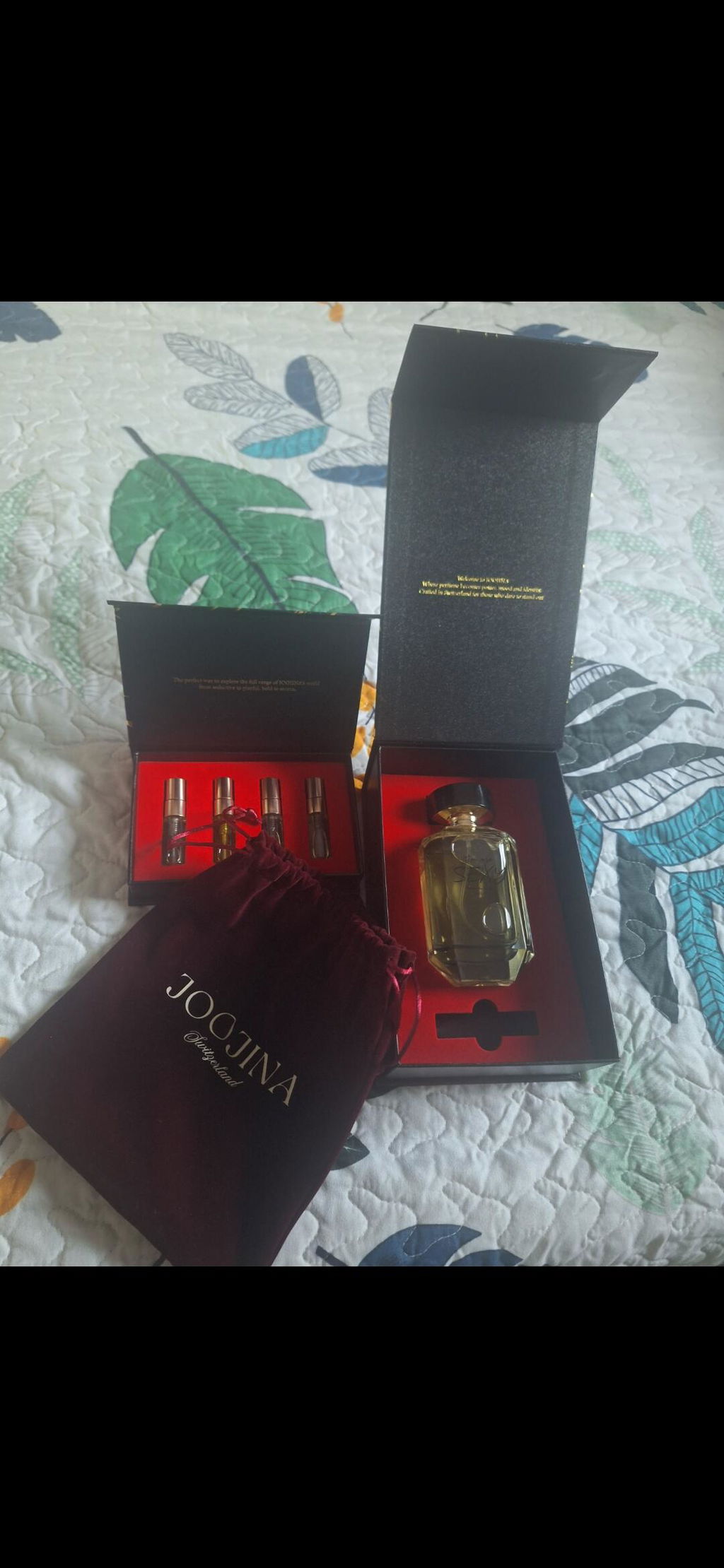
This is exactly what JOOJINA's Discovery Kit is designed for: 4 x 3ml samples of all four JOOJINA extraits, enough for multiple real-wear tests of each. The kit comes with a EUR 25 voucher toward a full-size bottle — so the EUR 25 you spend on the kit applies directly to the purchase if you decide to commit. You're not paying to sample; you're paying a deposit on a potential purchase.
At 3ml per sample, each vial gives you 3-4 full wearings at extrait concentration. That's enough time to understand how the fragrance opens, how it transitions, what it becomes on your skin in the evening, and whether you actually want to smell like this for the next year. That information is worth EUR 25 regardless of whether you buy a full bottle.
The Verdict
Is extrait de parfum worth it? For daily wearers who value longevity, complexity, and not reapplying mid-day: yes, unambiguously. The cost-per-wear arithmetic is neutral at worst and favourable at best. The ingredient quality is genuinely higher. The experience — the way a real extrait evolves across twelve hours — is something an EDP simply cannot replicate at the same formula depth.
The "luxury tax" concern is legitimate when applied to the right targets: designer fragrances with massive advertising budgets and economical formulas. It doesn't apply to small niche houses where the price is cost of materials, not cost of perception management.
If you're curious and haven't committed yet, that's the right instinct. Test first. Wear it. Then decide.
Frequently Asked Questions
How many sprays of extrait de parfum should I use?
Significantly fewer than you'd use with an EDP or EDT. Start with 1-2 sprays on pulse points — inner wrists, base of throat, or behind the ears. Extrait de parfum is dense; the temptation to apply more because the opening seems quiet is one to resist. Give it 20-30 minutes. It opens slowly and can become overwhelming if over-applied. Less is genuinely more.
Does extrait de parfum expire faster than EDP?
No — in fact, the higher concentration of aromatic compounds relative to alcohol means extrait de parfum tends to be more stable over time. The alcohol in lower concentrations is a minor preservation factor, but the higher oil content in extraits is not a liability. Store any fragrance away from direct light and heat, and it will remain stable for 3-5 years after opening, often longer.
Is the higher price of extrait de parfum just for the concentration, or are the ingredients actually different?
Both. The concentration itself requires more aromatic materials per bottle, which costs more. But beyond that, fragrances formulated as extraits tend to use higher-grade materials because at that concentration, the quality of each ingredient is more apparent. A synthetic shortcut that disappears in an EDP is unmistakable in an extrait. The formula quality and the concentration are inseparable at the top end of perfumery.
Can I wear extrait de parfum to work or is it too strong?
Yes, absolutely — with the right application. Apply 1-2 sprays to covered skin (inner forearm, chest under clothing) rather than to exposed pulse points if you're in a close-quarters office environment. Covered skin slows diffusion and keeps the projection intimate rather than filling the room. An extrait applied correctly is not more aggressive than an EDP over-applied; it's a matter of knowing how to wear it.
Experience the Difference Yourself
Reading about extrait de parfum only takes you so far. The actual test is wearing it — feeling how it settles on your skin, how it changes through the day, whether it fits the life you actually live.
JOOJINA's Discovery Kit (EUR 25) includes 4 x 3ml samples of all four JOOJINA extraits — YOU ARE SEXY, OH LALA!, Eau Boisee, and Oops I Did It Again — plus a EUR 25 voucher toward a full-size bottle. Enough material for multiple full-day tests of each fragrance. The EUR 25 applies to your first full-size purchase, so if you find your fragrance, the kit cost you nothing.
Keep reading
See why concentration drives longevity in Long-Lasting Perfume for Women, or explore individual notes: vanilla, oud, musk.