Perfume Notes Explained: Top, Heart, and Base Notes Guide
Share
Perfume notes explained simply: every fragrance you've ever worn is a three-act structure playing out on your skin over hours. What you smell the moment you spray is not what you'll smell at lunch, and what lingers on your collar the next morning is something else entirely. Understanding how top, heart, and base notes work doesn't just help you talk about fragrance — it helps you buy smarter, wear more intentionally, and actually understand what's happening when a scent surprises you halfway through the day.
This is a practical guide. No jargon for its own sake. By the end, you'll be able to read a fragrance note list and have a real sense of what to expect — and you'll know why testing a perfume on paper tells you almost nothing useful.
Why Perfume Notes Explained Matters for Buying
Most people smell a fragrance on a strip or on their wrist in a shop and make a decision based on that 30-second impression. Then they wear it for a day and discover the fragrance they bought is not the fragrance they're living with. The top notes — fresh, bright, first-impression — have burned off, and the base they didn't evaluate is now what they're wearing.
This mismatch is the single biggest source of fragrance regret. Understanding the three layers prevents it.
It also matters for pairing, layering, and occasion-dressing. If you know your fragrance opens sharp and citrus-bright but settles into a deep, animalic musk by evening, you know it's probably not your boardroom scent for 9am but is exactly right for dinner at 8pm. The fragrance hasn't changed. Your understanding of it has.
Top Notes: The First Impression
Top notes are what hits you in the first 15-30 minutes after application. They're the lightest, most volatile aromatic compounds in the formula — meaning they evaporate fastest. Their job is to create an immediate, attractive first impression before handing off to the heart of the fragrance.
Top notes tend to be sharp, bright, and fresh. Think of slicing a lemon and holding it to your nose — that immediate acidic brightness, the thin spray of citrus oil that reaches you before you've even brought the fruit close. That quality of immediacy and lightness is characteristic of most top notes. You smell them with your whole face, not just your nose.
Common top note families include:
- Citrus: bergamot, lemon, grapefruit, orange, yuzu
- Light herbs: basil, mint, green tea
- Light fruits: apple, pear, peach (the airy, fresh facets)
- Aldehydes: synthetic notes that give soapy, powdery brightness (classic in Chanel No. 5)
- Light spices: pink pepper, cardamom (bright facets, not the warm depth that comes later)
The challenge with top notes: this is what most people evaluate in a shop. The quick spray, the quick sniff, the decision. But the top notes last 15-30 minutes and then largely disappear. What you're buying is what comes after.
This is why skin testing over time matters. See our guide to finding your signature scent for a practical approach to evaluating fragrances properly before buying.
Heart Notes: The Soul of the Fragrance
Heart notes — also called middle notes — emerge as the top notes fade, typically from 30 minutes to several hours after application. They are the core character of the fragrance: where the perfumer's real intention lives. When someone says "this is a floral fragrance" or "this is a spicy oriental," they are usually describing the heart.
Heart notes tend to be fuller, rounder, and more complex than the top. Where a citrus top note might be thin and linear — pure brightness — a rose heart can contain dozens of sub-facets: honey, green stem, pepper, powder, fruit, leather, depending on the variety and how it's extracted. The heart is where you start to understand what the perfumer was actually thinking.
Common heart note families:
- Florals: rose, jasmine, ylang-ylang, iris, peony, tuberose, magnolia
- Soft spices: cinnamon, nutmeg, clove (warming, not sharp)
- Fruity: darker fruits — plum, fig, blackcurrant, dried dates
- Green/herbal: geranium, violet leaf, lavender (in its warmer phase)
- Light woods: cedarwood at its brighter facets, pine
The heart is where a fragrance reveals whether it's linear or complex. A linear fragrance smells more or less the same from heart through base — predictable, consistent, often pleasant but not particularly surprising. A complex fragrance uses the heart to shift tonality: a fragrance that opens with something clean and green might reveal a rich, honeyed floral heart that makes you look at your wrist and wonder if you applied something different.
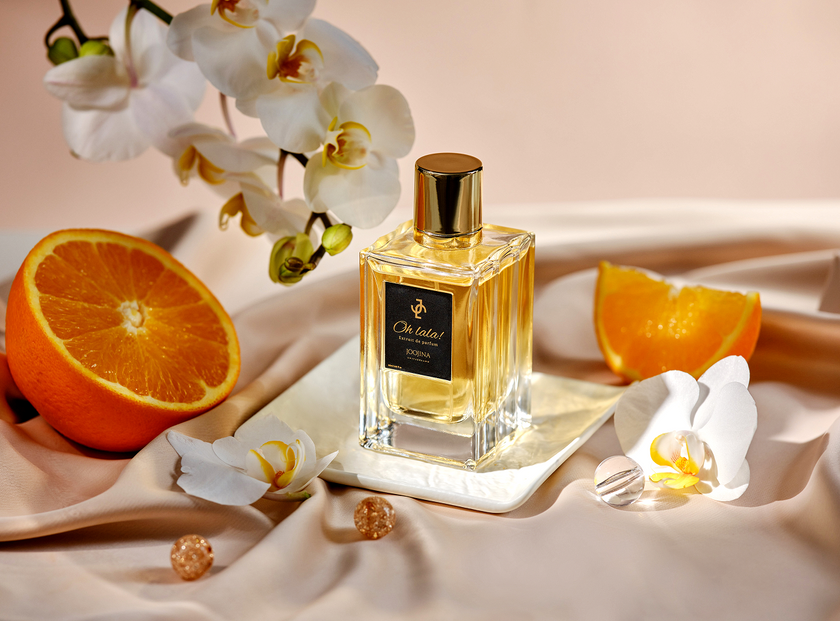
In OH LALA!, JOOJINA's warm and joyful extrait, the heart is where the fragrance most fully expresses its character — the playful warmth that makes it recognisable across the day is anchored in the heart notes, which build on a lighter opening and soften into the base without losing their essential vivacity. Apply it on a warm morning and by mid-morning you understand exactly what it is: something that smells like being in a good mood.
Base Notes: What Stays With You
Base notes are the heaviest, least volatile aromatic compounds in the formula. They take the longest to emerge — often not fully apparent until 3-4 hours into wearing — and they're what lingers longest. The base is what you smell on your scarf the day after. It's the impression left in the crook of a neck. It's what people are describing when they say a fragrance has "depth."
Base notes are often described in terms you can almost feel rather than just smell. Deep, warm, resonant, heavy, textured. Sandalwood has a smoothness like polished wood that you almost sense through your fingers. Vanilla wraps around you like something edible. Vetiver from Réunion or Haiti has an earthy, smoky quality that reads differently in different lights — almost metallic in one moment, almost clean in another.
Common base note families:
- Resins and balsams: amber, benzoin, labdanum, frankincense
- Woods: sandalwood, cedarwood (deeper facets), vetiver, oud, patchouli
- Musks: white musk, ambrette, ambergris — the skin-close warmth at the very end
- Vanillic: vanilla, tonka bean, coumarin (the warm sweetness that rounds edges)
- Animalic: civet, castoreum, leather — the notes that make fragrance feel alive on skin
Base notes also serve a structural function: they're the fixatives that slow the evaporation of heart and top notes, extending the fragrance's life on skin. A formula with no substantial base evaporates quickly and completely. A formula with rich base notes holds the whole structure up — which is one reason extraits de parfum, which use heavier concentrations of these denser materials, last so much longer than lighter concentrations.
Eau Boisee, JOOJINA's woody, refined extrait, demonstrates this beautifully. The base is where it lives most fully — rich, structured woods that settle into skin and stay there for hours after the top has long since departed. Applied in the morning, by evening it has become something architectural: less a scent than a presence. You stop noticing it as a smell and start noticing it as part of how you feel.
How the Three Layers Work Together: The Accord
The terms top, heart, and base suggest a sequential progression — first this, then that, then this other thing. In reality, the layers overlap and interact continuously. A great fragrance isn't three separate performances; it's a chord that changes character as individual notes fade in and out.
The word perfumers use for this is accord — a harmonic blend where individual notes are no longer individually identifiable but create a unified character together. The best fragrances don't smell like a list of ingredients. They smell like a feeling, a place, a moment. That happens when the accord is well-constructed and the transitions between layers are smooth rather than abrupt.
This is why cheap fragrances often feel "thin" or "synthetic" even when you can't identify exactly what's wrong. The accord is poorly constructed — notes don't connect, the transition from top to heart is jarring, the base arrives without having been prepared for. Conversely, the reason some fragrances cost what they do is that the accord required many iterations, rare materials, and a trained nose to get right.
JOOJINA's Oops I Did It Again is a useful example of a well-constructed accord: spontaneous and charming in character, it achieves this not through any single remarkable note but through the way the notes speak to each other — the opening promises something playful, the heart delivers on it, and the base extends that quality without changing the fundamental character. It smells like a coherent thought rather than a list.
A Reference Table: Common Perfume Notes by Family and Position
| Note Family | Typical Position | Common Ingredients | Sensory Character |
|---|---|---|---|
| Citrus | Top | Bergamot, lemon, grapefruit, yuzu | Sharp, bright, immediately refreshing, brief |
| Herbal / Green | Top–Heart | Basil, mint, violet leaf, geranium | Clean, fresh-cut, slightly sharp |
| Floral | Heart | Rose, jasmine, tuberose, iris, peony | Rich, round, complex — range from delicate to opulent |
| Spicy | Heart–Base | Cinnamon, cardamom, pink pepper, clove | Warming, tingling, adds energy to heavier notes |
| Fruity | Top–Heart | Peach, plum, blackcurrant, fig, pear | Sweet, round, juicy or jammy depending on the fruit |
| Woody | Base | Sandalwood, cedarwood, vetiver, oud, patchouli | Dry, textured, warm — the structural backbone |
| Resinous / Balsamic | Base | Amber, frankincense, benzoin, labdanum | Warm, slightly sweet, enveloping — feels ancient |
| Musk | Base | White musk, ambrette, ambergris | Skin-close, clean or animalic, the last thing to linger |
| Vanillic | Base | Vanilla, tonka bean, coumarin | Sweet, edible, comforting — rounds sharp edges |
| Animalic | Base | Leather, castoreum, civet (now mostly synthetic) | Warm, bodily, intimate — makes fragrances feel alive |
Reading a Fragrance Note List: What to Actually Look For
When you see a fragrance listed with top notes, heart notes, and base notes, you're reading a simplified map of the formula. The actual composition might involve 50-100 individual aromatic compounds; what you see in the marketing description is the perfumer or brand highlighting the most prominent or notable ones in each layer.
A few practical things to look for:
Heavy base notes dominate the wearing experience. A fragrance with musk, amber, and sandalwood at the base is going to feel warm and dense for most of the day, regardless of how fresh the top notes are. The top notes introduce it; the base defines it.
Multiple florals in the heart don't mean a generic floral. Rose + jasmine + iris is not just "flowers." Rose adds velvet and honey, jasmine adds indolic richness (a quality perfumers describe as almost bodily), and iris adds powder and cool elegance. That combination creates something specific and distinct.
The presence of oud, tobacco, incense, or vetiver in the base signals longevity and complexity. These materials are heavy, tenacious, and complex. A fragrance built on these will wear differently at 2pm than at 8am and differently again at midnight.
No note list tells you how balanced the formula is. A note list tells you what's in there, not how skillfully it's been composed. Two fragrances can share identical note lists and smell completely different because of the ratios, the quality of materials, and the skill of the perfumer.
The JOOJINA Fragrances Through the Lens of Notes
Understanding note structure helps explain why each JOOJINA extrait has its own personality that unfolds differently across the day.
YOU ARE SEXY is built for presence and sensuality. Its top is direct and confident — nothing tentative about the opening. As the heart develops, the fragrance shifts toward something warmer and more intimate, and the base carries an almost tactile quality: the kind of warmth you feel as much as smell. Worn on an evening out, the progression from first spray to dinner is its own narrative arc.
OH LALA! is designed to feel joyful and warm. The top is accessible and immediately pleasing — you'd wear it on a bright Saturday morning without thinking twice. The heart is where its warmth comes from, and the base anchors that warmth without tipping into something heavy. It's a fragrance that doesn't demand attention but rewards it when you bend toward your own wrist and inhale.
Eau Boisee is structured around its base in a way that the other three fragrances are not. The woods are not background — they are the point. The top and heart prepare you for what the base delivers: a refined, dry, architectural depth that is best understood not in the first five minutes but hours into wearing when the fragrance has completely settled into your skin.
Oops I Did It Again plays with spontaneity in its note structure — it has a quality of slight unexpectedness as it transitions. The opening suggests one thing; the heart delivers a gentle pivot; the base settles into something charming that seems obvious in retrospect. It's the kind of fragrance that makes people say "what are you wearing?" not because it's aggressive but because the accord is just slightly unusual in the best possible way.
Using Note Knowledge to Layer Fragrances
Once you understand note structure, layering becomes an intentional practice rather than guesswork. The principle: layer fragrances from heavy to light, applying the heavier base-dominant fragrance first and the lighter one on top. The heavy base-note fragrance acts as an anchor; the lighter fragrance rides over it and fades faster, leaving the heavier one to carry through.
This works particularly well when one fragrance has notes that complement or extend the other's base. A woody extrait under a fresh floral creates a grounded floral that doesn't feel airy or fleeting. A vanillic base under a citrus-forward fragrance creates a creamsicle quality that neither fragrance alone would achieve.
For a full guide to layering technique, including specific combinations that work well together, see our Perfume Layering Guide. And if you're looking for fragrances to build a wardrobe around, the full JOOJINA collection offers four distinct character profiles that layer well with each other precisely because they were designed with this kind of interplay in mind.
One Mistake to Stop Making
Spraying fragrance on paper and deciding. The paper tells you almost nothing about how a fragrance will wear. It shows you the top notes and some of the heart, under artificial conditions, with no skin chemistry involved. The base barely appears on paper. The accord doesn't unfold the way it does on warm skin. The longevity is completely different.
The only meaningful test is skin time — spray it, wear it for 4-6 hours, assess it in stages. That's how you learn what the fragrance actually is. The first five minutes are not the fragrance. They are the introduction to the fragrance.
Frequently Asked Questions
How long do top, heart, and base notes each last?
Top notes: 15-30 minutes, sometimes up to an hour for heavier top notes like pink pepper. Heart notes: from roughly 30 minutes to 2-4 hours, sometimes longer in richer formulas. Base notes: from the 2-hour mark onward, often lasting 6-12 hours at extrait concentration, and occasionally lingering on fabric or hair for 24 hours or more. These are general ranges — skin chemistry, temperature, humidity, and formula concentration all affect the timeline significantly.
Can I smell all three note layers at once, or do they always appear in sequence?
In practice, the layers overlap continuously rather than switching cleanly. You may smell hints of the heart even in the first few minutes; base notes can make themselves felt before the top has fully faded. What the note structure describes is when each layer is most prominent, not an exclusive sequence. A well-composed fragrance is always a blend; the proportions of that blend shift across time.
Why does the same perfume smell different on different people?
Skin chemistry is the primary reason. Skin pH, body temperature, moisture level, diet, and even stress hormones affect how aromatic compounds interact with your body. Some people's skin amplifies certain notes — florals become sweeter, woods become drier, musks become more animalic. Others neutralise the same materials. This is why wearing a fragrance on your own skin is the only reliable test, and why it's also why the same fragrance can smell completely different on a partner or friend.
What is a "linear" fragrance and is it bad?
A linear fragrance smells essentially the same from application through dry-down — the note profile doesn't evolve significantly. This is not inherently bad; linear fragrances are often clean, versatile, and easy to wear precisely because they don't surprise you. A complex, evolving fragrance can be more interesting but also more demanding — you need to like where it ends up, not just where it starts. For everyday wear, many people prefer linear; for special occasions or signature scents, the depth of a more complex accord is often what they're seeking.
The Best Way to Learn Notes Is to Smell Them
Reading about top, heart, and base notes builds the framework. What makes it real is experiencing each layer — recognising the citrus brightness of a top note giving way to the floral warmth of a heart, then noticing how a woody base arrives and anchors everything hours later.
JOOJINA's Discovery Kit (EUR 25) includes 4 x 3ml samples of all four JOOJINA extraits — YOU ARE SEXY, OH LALA!, Eau Boisee, and Oops I Did It Again. Each sample gives you 3-4 full-day wearings: enough to experience the full note arc of each fragrance, observe how the layers behave on your specific skin, and understand in practice what this guide explains in theory. The kit includes a EUR 25 voucher toward your first full-size bottle — so if you find the one, the samples cost you nothing.
Explore the notes in depth
Want to go deeper on a specific scent family? Read our guides to vanilla perfume, oud perfume, musk perfume and amber perfume.